
📍
Choose the location
Pick a representative, open spot near the boundary or main activity, away from walls and exhaust that could bias readings.
A monitoring station is typically pole-mounted with sensors near the top, the LED board at viewing height and the controller and power in a weatherproof box below. Site it in a representative location, away from direct obstructions.
 Installed at the boundary or main activity zone of the site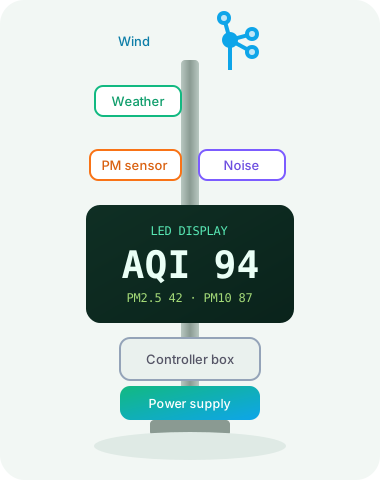
From top to bottom, a common installation stacks the components on a single pole:
Temperature, humidity, pressure, rain — near the top, clear of obstructions.
Anemometer + vane at the highest point for clean airflow.
Laser dust sensor at breathing height, in a ventilated shield.
Weather-protected microphone facing the activity.
At readable viewing height for workers and passers-by.
Weatherproof enclosure and power supply at the base.
Pick a representative, open spot near the boundary or main activity, away from walls and exhaust that could bias readings.
Install a stable pole with a concrete or ballasted base able to withstand wind loading.
Fit weather, wind, PM and noise sensors at the recommended heights per the manufacturer's guidance.
Mount the display at viewing height and orient it toward the audience (gate, road or site office).
Connect sensors to the controller in the enclosure and hook up mains/UPS/solar power.
Insert the 4G SIM or connect Wi-Fi, verify cloud upload, then calibrate and validate readings.
Standard grid power where a supply is available on site.
Keeps monitoring running through power cuts and load-shedding.
Self-powered stations for remote sites with no reliable grid.
The components in a complete monitoring station and what each one does.
| Component | Typical purpose |
|---|---|
| PM2.5 / PM10 sensor | Dust monitoring |
| Temperature / humidity sensor | Weather monitoring |
| Noise sensor | Noise monitoring |
| Wind speed sensor | Wind measurement |
| Wind direction sensor | Wind direction |
| Rain gauge optional | Rainfall |
| Controller | Data acquisition |
| 4G modem | Connectivity |
| LED display | Public display |
| Waterproof enclosure | Electronics protection |
| Pole & mounting | Installation |
| Power supply | System power |
Turnkey deployment — from the pole and enclosure to commissioning the cloud dashboard and validating your first readings.